Friday, February 1, 2013

Bronze Whaler Shark The Unique Animal


The Bronze Whaler shark name sometimes used for several species of tropical whale shark. Many shark species can display a bronze coloration when facing bright sunlight. In Australia and many English-speaking countries other Carcharhinus brachyurus, Bronze whale shark is considered true. This species is also known as Copper Shark, particularly in South Africa and Namibia.

Bronze Whaler shark is a large species and can reach a maximum size of at least 325 cm and weigh up to 250 kg. Bronze Whaler shark has a blunt nose and a sharp moderately long broad rounded or pointed. There is a narrow, bent valve on top of the shark teeth. Bronze Whaler Shark do not have lines in between. The upper part of the body showing gray and olive bronze, while the belly is white. Fins plain, but a dark fin tip and tips hip and back sides of the pectoral fins are dark or black. Just like other shark species, Bronze Whaler shark has a skeleton made of cartilage instead of bone. The cartilage is a flexible material, and also found in the human body, for example at the end of the nose and the outer ear. Cartilage is very flexible when it is formed, but the body uses calcium to harden it and is strong enough to support a large shark in the water body. Shark family is very old and has been around for over 350 million years. Along with shoes and rays, shark species is the only non-endangered fish with cartilage instead of bone.

Bronze Whaler shark inhabits most of the world and is found in the waters around all the continents except for cold waters around Antarctica. In the Western Atlantic and Gulf of Mexico that inhabited the water from Brazil and down to Argentina. Bronze Whaler shark also live off the south coast of France and around the coast of the African continent. It is generally found in the Mediterranean. In the Western Pacific Bronze Whaler shark is found from Japan to New Zealand, and in the Eastern Pacific from Southern California region inhabited in the U.S. and all the way to Peru, including the Gulf of California.

The Bronze Whaler shark that inhabits the northern province of large travel distances planet each year and migrate south for the winter and back north for the summer.

Bronze Whaler shark like tropical and subtropical waters, and is found from 45 ° N to 52 ° S. It is associated with coral reefs and is known to dive to at least 100 meters. In shallow areas can be found near the bottom. This is the last species of coastal areas often often go along the edge of the continent. The Bronze Whaler sharks are also sometimes considerable effort to bay beaches and other coastal areas. It is generally found in ocean waters, but also have been seen in the area of ​​culture.

This bony fish feed mainly pelagic and bottom, particularly swordfish and shark swordfish. It is also known to take other sharks, mullet, rays, and squid. The annual sardine run off the coast of South Africa always attract abundance Bronze Whaler shark.

Bronze Whaler shark is very popular among fishermen and often caught when fishing hook. Nevertheless one of the most slow shark species grow, which makes it very vulnerable to over-fishing. The minimum population doubling time for Bronze Whaler shark more than 14 years. Bronze Whaler shark was involved in a shark attack on society and should always be approached with caution. The best way to prevent attacks is to stay away from the sharks and never even try to reach out even if looks relaxed.

Over the last few years Bronze Whaler shark has been the focus of scientific projects that utilize satellite technology to monitor migration patterns. This has produced amazing results and today scientists suspect that there are at least two different populations of the Bronze Whaler shark off the coast of South Africa. The first live east of the Western Cape, while the other population is found in Walvis Bay in Namibia and Angola off to the north. The Bronze Whaler shark found off Namibia and Angola belong to the same population and travel between countries. Two shark marked in southern Angola in 2003 which is located in Swakopmund in Namibia three months later, 715 miles south of the southern Angola.

Bronze Whaler shark is carrying inner life and Bronze Whaler shark pup female will give birth to life. This forms a species pair and the fertilized egg in the female, while the male hug him. Bronze Whaler shark breeding methods are viviparous and descendants receive nutrients from the yolk-sac placenta as they develop in their mother's body. One liter will consist of between 7 and 20 puppies and newborns Bronze Whaler shark pups usually 59-70 cm. Bronze Whaler shark give birth year-round, but there is a peak during the summer.

Thursday, January 31, 2013

Blue Whale The Biggest Animal in World


Blue whale classification
Blue whales are marine mammals including the genus Balaenoptera in Balaenoptiidae family. Is the scientific name Balaenoptera musculus. There are three recognized subspecies of Balaenoptera musculus. Named Balaenoptera musculus musculus subspecies found in the north Atlantic and the north Pacific Ocean. Subspecies named Balaenoptera musculus intermedia is not native to the southern part of the world. The third species, Balaenoptera musculus brevicauda often referred to as the Little Blue Whale and live in the Indian Ocean and in the southern part of the South Pacific. If you read the texts of the older of the blue whale you might find a fourth subspecies, indica Balaenoptera musculus. Today, the most powerful Blue whales do not agree however that the whale Balaenoptera musculus brevicauda subspecies belonging.

Blue whales name
Blue whales are known by several different common names in addition to blue whales, such as the Great Blue Whale, Sibbald's Rorqual, Rorqual Great Northern and sulfur-bottom whale. The second part of the scientific name of Blue whale, musculus, can be defined as the "muscle" and "little mouse" in Latin. Blue Whale was named by Carl Linnaeus academic year 1785.

Blue whales food type
Blue whales feed primarily on krill, but studies have shown that sometimes may also swallow small fish, squid and animals that accidentally caught during a blue whales filter krill. Krill are small marine crustaceans, such as shrimp and zooplankton form. All sequences belonging to various species of Krill and krill Euphausiacea therefore sometimes referred to as Euphausiids.

Blue whales feed on a variety of different species of krill. The blue whales that live in the North Pacific will eat a lot of Euphausia pacficia example, Nyctiphanes symplex, Thysanoessa inermis, Thysanoessa longipes and Thysanoessa spinifera. A blue whales live in the North Atlantic but will feed mainly on Meganyctiphanes norvegica, Thysanoessa inermis, Thysanoessa longicaudata and Thysanoessa raschii. Blue whales inhabit the cold Antarctic waters known to have Euphausia crystallorophias, Euphausia Superba and Euphausia vallentni as their main food source.

Blue whales feeding
Blue whales feed by taking a large amount of water into its mouth and squeezing it out through the baleen plate  it mentioned that act as filters. Water is forced out of the mouth of a blue whale ventral bag and tongue. The krill is too large to pass through the plate Baleen and be swallowed by a blue whale as soon as the water has been squeezed out of his mouth.

Blue whales are always trying to find dense krill concentrations likely to receive adequate amounts of nutrients. Therefore they would normally spend their days at depths below 100 meters and feed near the surface during the night. A blue whale feeding dives are more likely to last between 10 and 20 minutes. The longest recorded dive is 36 minutes long.

Wednesday, January 30, 2013

Humpback Whale The Whalebone Whales Animal

Humpback whale classification
Humpback whales are marine mammals in Megaptera Balaenoptiidae genus and family. Megaptera novaeangliae scientific name is and that is one of the Baleen whale mentioned in Mysticeti subordo. Pope Baleen also known as whale bone whales or great whales, and differentiate yourself from the Cetacea subordo toothed whale with plates Baleen not have teeth. Baleen pancakes used to filter water.

Humpback whale ranges
Humpback whales inhabit all oceans of the world, from the Antarctic ice edge to about 65 ° N latitude. They do not live in the Baltic Sea, the Mediterranean or the Arctic Ocean. During the summer, you will find Humpbacks in cold water is located at high latitudes. They migrate to the waters of the tropical and sub-tropical that can mate and have their calves. Hump ​​back whales are mammals beruaya and annual visits to 16.000 miles (25.000 kilometers) are common. Population of the Arabian Sea but did not migrate, it remains in warm water 12 months of the year.

Humpback whale description
Humback whale body is not as thin and slender as other rorqual body, but still quite effective. Stock tail (base) narrow and slender. If you watch the whales from above, the head broad and knowledgeable, but if you even watch the whales from the side looks pretty slim. Humpbacks have 20-35 ventral groove, which extends slightly beyond the center. Slouching top of the head and also because the lower jaw bump sporting shaped buttons. This button contains one or a few stiff hair. We do not yet know for sure why the buttons and hair development, but they may give humpback whale with tactile senses. They may be similar to cat whiskers.

Humpback whale food
Humpback whales feed during the whole summer and take place on their energy available during the winter. They are skilled predators and take a wide choice of different victims, from tiny krill to herring, capelin, sand lance and large schools of fish.

Humpback whales catch prey with a direct attack, but also common for whales to stun prey by hitting the water around the prey with a powerful worm and / or fins. Humpbacks group is also known to work together in the so-called "bubble netting fish". During the bubble net fishing, Humpbacks make a bubble tube large enough to trap air around the school of fish.

Humpback whale watching
Humpbacks tend being very inquisitive and they will often approach boats and live in a small distance from them. This naturally big loss for humpback whale population during the 20th century when they were hunted as a whole from the ship, but only a few countries currently involved in the hunt humpback whale. Curiosity humpback whales today make popular pets among whale watchers. You can take part in a whale traveling in different parts of the world, including Byron Bay north of Sydney, the Bay of Biscay west France, western peninsula Snæfellsnes Iceland, Newfoundland coast and Vancouver in Canada and along the St. Lawrence River north .. In the United States, watch Humpback whales occur along the sides of the Atlantic and Pacific coast. You can for example get a whale boat in Washington, New England, Alaska and Hawaii

Tuesday, January 29, 2013

Great White Shark The Amazing Water Predator


The Great White Shark is macropredator found especially in temperate seas and oceans, but the Great White Shark may also be occasional tropical waters. This is especially an inmate epipelagic, meaning that it can usually be found in the upper layer of the ocean, usually between the sea surface and the thermocline at a depth of about 200 meters. The Great White Shark is known However bold sometimes well below 250 meters. It can be found in the waters serfline and very far from the beach. The Great White Shark is available from offshore islands where the water is deep and shallow beach located close to each other, and offshore reef fish can be found.

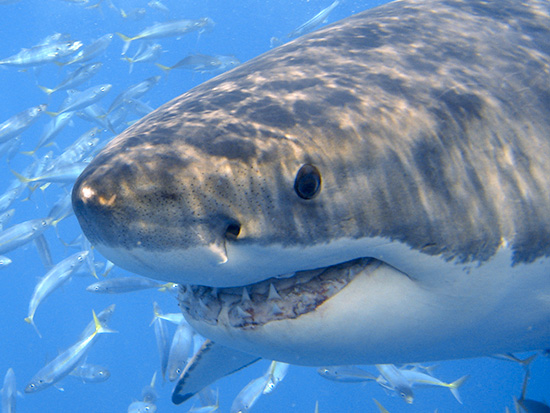
Great White Shark is actually not just white. Above, their color varies from almost black to gray while the ventral surface is white or whitish. Hip fins can be seen with olive and gray. In strong sunlight, lateral surface can display almost bronze colored sheen. The area surrounding the gill-slit and on the basis of fins often blotched. The same thing happened with the small, dark spots or dark irregular on the sides of the posterior to the fifth gill slit. Every Great White Shark has a individual coloring and patterns, but there are also similarities district. For example, the Great White Shark off Cape Province in South Africa generally show more olive tones, while the Great White Sharks off California in the U.S. has coloring very dark gray. Great White sharks in the Mediterranean Sea are usually olive-brown or gray.

There's always a lot of speculation about the maximum size of the Great White Shark. Unconfirmed sources claim that large female White Shark over 7 meters look out Kangarro Island in Australia in 1987. In the same year, shark female from Malta reported as 713 centimeters. In October 1998, a picture of this yet examined sharks and shark turned out to be more than 530 centimeters. Most experts believe that the maximum length of the Great White Shark is somewhere around 6 meters. The smallest adult Great White Sharks found in the wild is around 120 centimeters. We still do not know for certain length at maturity for the Great White Shark, and it is possible that different populations reach maturity at different lengths. But we know that the female Great White Shark often mature when they are between 450 and 500 centimeters, and that male Great White Shark often mature when they are around 350 centimeters. A study on the Great White Shark 21 show that they mature when they are around 10-12 years, but this is just an individual study on quite a few individuals and can not be used to make general assumptions.

The Great White Shark has a conical nozzle, with a somewhat blunt. Large teeth, shaped like a triangle and rough-sawn placed in patterns like. Their Latin name, Carcharodon carcharias, actually means "jagged-toothed One '. The Great White Shark is equipped with five large gill opening. The first dorsal fin is almost an equilateral triangle, with somewhat concave rear margin. In very young individuals, the first dorsal fin rounded at the apex, and grew pointier during the first two years. The second dorsal fin is always very small at the Great White Shark. Crescent-shaped tail fin, and the Great White Shark is greater than 2.0 meters usually have acute end point. In the newborn sharks, the lower surface of the tail is generally more compressed and round. This area but will grow rapidly after birth and will look like the surface of the tail of a large adult White Shark.

The Great White Shark Carcharodon genus belonging and close relative called four other mackerel sharks in the family Lamnidae. Most historians agree that when Aristotle and other Greek writers write about "the Lamia scary monster" they refer to the animals we now call the Great White Shark. Lamia and Lamie name is still used in some Mediterranean language, such as Greek and the language of southern France. During the 16th century naturalist Guillaume Rondelet suggest that perhaps the prophet Jonah in the Bible is not swallowed by the whale, but the Great White Shark. Just like today, the Great White Shark is well feared and admired, and surrounded by a lot of rumors. Historically, the Great White Shark has been known by several different names. There is always only one who recognized white shark species, but has been mentioned Squalus carcharias, Lamia carcharias, Verus carcharias, Carcharodon rondeletii, and Squalus carcharias Carcharodon smithii. Currently, formal latin name Carcharodon carcharias, which means A jagged-toothed.

Detailed knowledge about the reproductive habits of the Great White Shark rare, but at least increased rapidly over the last few years. Previously, most of the ideas and know about Great White Shark breeding is based on a comparison with other related species of shark that is known to the scientific community. There is a report from 1937 on the arrest of pregnant shark three years earlier, but was not sure if this is the Great White Shark or some other species. It was not until the 1980's that a more detailed study of the Great White Shark pregnancy occurs. Confirmed reports speak about 5 to 10 embryos, but there are also unconfirmed reports that around 14 embryos. Yu girls develop placenta is not available, and even embryos preserved by unfertilised egg consumption (oophagy). Embryos also swallow their own teeth warehouse, presumably to return to the calcium and other minerals, but is yet to be confirmed. Time of pregnancy is unknown, but is estimated at around 12 months. Birth may occur in temperate shelf waters from spring to late summer. A Great White Shark newborn is between 120 and 150 centimeters.

The actual coitus not witnessed, but the surface of the curious behavior performed by Great White Shark that may be part of the mating ritual has been observed. Mating rituals of other species of sharks often include biting and gripping with the teeth, and the bite mark was found on the pectoral fins, hips, and dorsum of the female Great White Shark which shows that this may be part of their mating ritual as well. Large adult Great White Sharks of both sexes and their offspring have been seen together in certain areas around the world, which may mean that the district nursing policy for the Great White Shark. Examples of such areas are the waters around Japan, South and East Australia, New Zeeland, South Africa's Eastern Cape Province, Southern California and Baha in the U.S. and South-Central Mediterranean Sea (especially between Tunisia and Western Sicily). Great White Shark was a little older, but still less than a year old, was arrested outside Algeria, North Aegean and France in the Mediterranean.

Monday, January 28, 2013

Blue shark is one of the fastest animal


Blue shark, Prionace glauca, easy to distinguish from other sharks in blue staining. Carcharhinidae this family owned, which means that it is a Requiem shark. When you watch the blue shark from the top you will see indigo blue color, while blue sharks observed from the side looks bright blue. White belly and tip of pectoral and anal fins have a dark color. Body elongated and slender blue sharks are usually able to achieve a measure 3.8 meters (13 feet), but the longest blue shark ever found even greater than that, and measured 400 cm. Blue sharks heaviest known weight is 205.9 kg. Very long pectoral fins of blue sharks always have the same size with the length of gill opening date and nozzle tip sharks. Snout long and has a conical shape. Upper lobe of caudal fin blue shark is far greater than the lower, and base of the tail has a weak keel. There is no line in between. All blue sharks have big eyes covered by a nictitating membrane.

Teeth in the upper and lower jaw that is equipped with a valve triangle or smooth jagged edges smooth. Serrated teeth for catching blue sharks facilitate smooth animals, such as squid. Teeth located in the line, and new teeth will smoothly rotate into place immediately after the old tooth was tired, lost or damaged. Blue Shark will only use the first two rows of teeth when hunting, other line only to play into place when needed.

Blue Shark is one of the fastest swimming shark, and can easily keep speed with the most fish species. Body long, slender and perfect for swimming fast as water-resistant to be very small. Large tail fin moving side to side and give a lot of strength for blue sharks. This swim with a sleek and powerful enough to make the leap out of the water. Further study is needed to confirm the maximum speed blue sharks. Some scientists estimate that the maximum speed to about 35 km / hour (22 miles per hour), while others claim that the maximum speed can be as much as 97 km / h (60 miles per hour).

The Blue Shark is found in most of the world, between 50 º and 50 º latitude LU S in offshore waters and coastal waters. It inhabits the Atlantic and Pacific Ocean and the Indian Ocean and liked both temperate and tropical waters. It is believed to be from the widest ranging chondrichthyian and is highly migratory. A blue shark off the coast of New Zealand tagged then found 1,200 miles off the coast of Chile. The Atlantic Blue shark follow warm Gulf Stream and traveled across the Atlantic each year. Their journey starts in the Caribbean Sea and the proceeds along the east coast and then to Europe. They then turned to the south and follow the coastline of West Africa before they turn south west and swim back to the Caribbean sea.

In the West you can see the Atlantic blue sharks from Newfoundland in Canada and down to Argentina. It is also found in the Middle Atlantic and from Norway to South Africa in the Eastern Atlantic. (The Mediterranean included.) In the Indo-West Pacific is spread from East Africa to Malaysia and Japan. It is often seen throughout Australia, New Zealand and New Caledonia. Eastern Pacific blue sharks inhabit the vast territory between the Gulf of Alaska and Chile.

Blue sharks are especially seafood, but also often found near coastal waters, especially where narrow continental landing. In temperate climates blue sharks will often stay close to the water surface in the pelagic region. In the warm tropical waters to dive deeper, because prefer water temperatures between 7 º and 16 º C are usually found further down. Blue sharks known depth range is from 0 to 350 meters, and generally found up to 150 m. Blue sharks will often form large schools. These schools are often composed of men only or women only, and all blue sharks are the same size. We still do not know why they do this, but maybe a way to prevent the attack from larger predators.

A blue shark bait especially in squid and bony fish. Pelagic fish usually formed the basis of Blue shark diet, such as swordfish, tuna, mackerel, cod, herring, and sea raven. Seal, flatfish, and pelagic red crab carcasses Cetacea also part of the normal diet. Blue sharks will often attack fish that are caught by long lines or similar capture tool, which unfortunately means that blue sharks often entangled in the equipment itself. Blue sharks are also known to occasionally eat seabirds and garbage.

Blue shark is believed to be one of the most breeding species of large sharks, but minimum population doubling time is more than 14 years. Viviporous breeding methods, which means that the eggs that develop into puppies in female blue sharks and receive nutrients in the body. After mating with a Blue Shark female can store sperm for several months, sometimes even years. The sperm covered in his oviducal gland where they will be given nutrients to stay alive. When he finally ovulates, fertilization occurs and Blue shark pups born alive after a period of 9 to 12 months of pregnancy term. One liter of blue sharks usually contains 25-50 puppies, large litters but as 135 have been reported. The larger the female blue shark, dog children more in each litter. Very small blue sharks can have litters with no more than 4 birds. A baby blue sharks dog is between 40 and 51 cm (16 inches and 20) long. A female blue sharks will not become sexually mature until it has grown to be at least 2.2 to 3.2 meters (7-11 feet), while the male blue sharks usually due at the time was between 1.8 and 2 , 8 meters (6 and 9 feet). Blue shark exceeds the maximum age of 20 years.

Blue shark always should be treated with caution as there have been reported attacks on humans. Blue shark hunted and sold as food. Meat sold fresh or preserved, and popular fin soup. Hiding from the Blue Shark applied to the skin. Blue sharks are classified as low risk / near threatened with extinction.