Sunday, January 13, 2013

Galapagos Penguin is Endangered Animal


The Galapagos Penguin (Spheniscus mendiculus) is a penguin endemic to the Galapagos Islands. This is the only penguin that lives north of the equator in the wild. This can take place because of the cold temperature produced from water and cold Humboldt current from great depths brought up by the Cromwell Current. The Galapagos Penguin is one of the banded penguins, other species that live mostly in coastal South American mainland, and Africa.

Galapagos Penguin average is 49 cm (19 in) long and 2.5 kg (5.5 lb) weight. This is the third smallest species of penguin. They have a black head with a white line running from the back of the eye, around the black feather ear and chin, to join on the throat. They have blackish-gray upperparts and white hamster, with two black bands on the breast, the lower band extends below the hips to the thighs. Teens different in a completely dark head, greyer on the sides and chin, and no breast-band. Female penguins are smaller than the males, but otherwise quite similar.

The Galápagos Penguin occurs primarily on Fernandina Island and the west coast of Isabela Island, but small populations spread over the other islands in the Galapagos archipelago.
While ninety percent of the Galapagos Penguins live in the western islands of Fernandina and Isabela, they also occur in Santiago, Bartolome, northern Santa Cruz, and Floreana. Northern tip of Isabela crossed the equator, which means that occasional Galapagos Penguins visit the northern hemisphere, the penguins just to do so.the penguins live in the archipelago. They live by Cromwell current day because of the cold and back to the ground at night. They feed on small school fish, especially mullet, sardines, and sometimes crustaceans. They search for food only during the day and usually within a few miles of their breeding site. They rely on a rich nutrient cold currents to bring them food.

The temperature on the island remains between 15 and 28 degrees Celsius (59-82 ° F). During El Niño season, penguins breed delay because they become less abundant food, this makes the possibility of increasing child succeeds disadvantage compared with the possibility of dying in labor. They usually breed when the sea surface temperature below 24 degrees Celsius (75 ° F), which produce more food for them. Strong sun is a major problem for the penguins. Their primary means of cooling off going into the water, but they have other behavioral adaptations because all the time they spend on the ground. They use two methods termoregulasi in warmer weather on land. One of them is to stretch their fins and bent forward to keep the sun from shining on their feet, because they can lose heat from their fins because blood flow there. They also pants, using evaporation to cool the throat and airway. Galapagos Penguins protect eggs and chicks from the hot sun to keep them in the crevices in the rocks.

This species is endangered, with an estimated population size of about 1,500 people in 2004, according to a study conducted by the Charles Darwin Research Station. More alarming population decline of 70% in the 1980s, but is slowly recovering. Therefore the rarest penguin species (status is often wrongly attributed to the Yellow-eyed Penguin). Population level is influenced by the effects of El Niño Southern Oscillation, which reduces the availability of shoaling fish, causing low reproduction or starvation. However, anthropogenic factors (eg oil pollution, fishing by-catch and competition) can add ongoing death of this species. On Isabela Island, introducing cats, dogs and rats attack penguins and destroy their nests. When in the water, they eat shark, fur seals, and sea lions.

There are couples procreate less than 1000 of the world's Galapagos Penguins. Breeding begins when sea surface temperatures drop to around 24 ° C. Most nests seen between May and nest January.The made in 50 meters (160 feet) of water on the beach, usually at Fernandina and Isabela Islands. Adults living near the county farm for years with their partner that they have chosen to live. When penguin breeding, incubation lasts 38-40 days with both parents help. After thirty days of the chicks were born and both parents responsibility division of treating them, the chicks have brown fur above and white below. The purpose of this is to protect the chicks from the strong sun more than keep them warm. Galapagos Penguins mate for life. This puts one or two eggs in places such as caves and cracks, protected from direct sunlight, which can cause overheating eggs. One of the parents will always remain with the eggs or chicks while the other does not appear for several days to feed. The elderly usually enlarges until only one child. If there is not enough food available, the nest may be abandoned. Bermudian naturalist Louis L. Mowbray is the first successful dikembangbiakkan Galapagos penguins in captivity.

Saturday, January 12, 2013

Bottlenose Dolphin a Smart Animal


Bottlenose dolphins, the genus Tursiops, are the most common member and well-known family Delphinidae, the family of marine dolphin. Recent molecular studies show the genus contains two species, common bottle dolphins (Tursiops truncatus) and the Indo-Pacific bottle dolphin (Tursiops aduncus), instead of one. Study in 2011 revealed a third species, Burrunan dolphin (Tursiops australis). They inhabit warm seas and being around the world.

Bottle dolphins usually live in clusters of 10-30 members, called pods, but group size varies from single individuals up to more than 1,000. Their diet consists mainly of fish food. Dolphins often work as a team to harvest fish schools, but they also hunt individually. Dolphins use echolocation to find survivors, which is similar to sonar. They emit sound pressing and listen to Echos back to determine the location and shape of the side items, including potential prey. Bottle dolphins also use sound for communication, including creaking and whistles emitted from the spray holes and the sound emitted through body language, such as leaping from the water and slapping their tails on the water surface.

There is a lot of research intelligence dolphin bottle. The study of dolphin mimikri bottles were examined, the use of artificial language, object categorization and self-recognition. Their great intelligence has driven interaction with humans. Dolphin bottle popular from aquarium events and television programs such as Flipper. They have also been trained by the military to locate sea mines or detecting and marking enemy divers. In some areas, they work with local fishermen by driving fish into their nets and eating the fish that escape. Some encounters with humans that is harmful to the dolphins: people hunt them for food, and dolphins killed accidentally as bycatch of tuna fishing.

They are gray, varying from dark gray at the top near the dorsal fin to the gray that is very light and almost white at the bottom. Countershading this makes them difficult to see, both from above and below, when swimming. Adult length ranges between 2 and 4 meters (6.6 and 13 ft), and weigh between 150 and 650 kilograms (330 and 1,400 lb). Men, on average, slightly longer and much heavier than females. In most of the world, the length of an adult is approximately 2.5 m (8.2 ft), with a weight range between 200 and 300 kilograms (440 and 660 lb). Their size varies with habitat. Except in the eastern Pacific, dolphins in the warm, shallow waters tend to be smaller than cold, pelagic waters. A study on the Moray Firth in Scotland, the population of dolphins second most northerly in the world, recorded an average adult length of just under 4 m (13 ft) compared to 2.5 m (8.2 ft) on average in a population off the coast of Florida.

Bottle dolphins can live for more than 40 years. However, a study of the population off Sarasota, Florida shows the average age of 20 years or less.

Their jaws elongated upper and lower forms what is called the pulpit, or nozzle, which gives the animal its common name. Nose, real work is blowhole on its head, nasal septum seen when open blowhole.

Bottle dolphins have 18 to 28 conical teeth on each side of each jaw.

The worm (lobe tail) and dorsal fin are formed of dense connective tissue and do not contain bone or muscle. Animals prompted her to move up and down the worm. Pectoral fins (on the side of the body) are for steering, they contain bones homologous to the forelimbs land mammals. A bottle of dolphin discovered in Japan has two additional pectoral fins, or "hind legs", in the tail, about the size of a pair of human hands. Scientists believe that the mutation caused the ancient trait to reassert itself as a form of atavism.

Friday, January 11, 2013

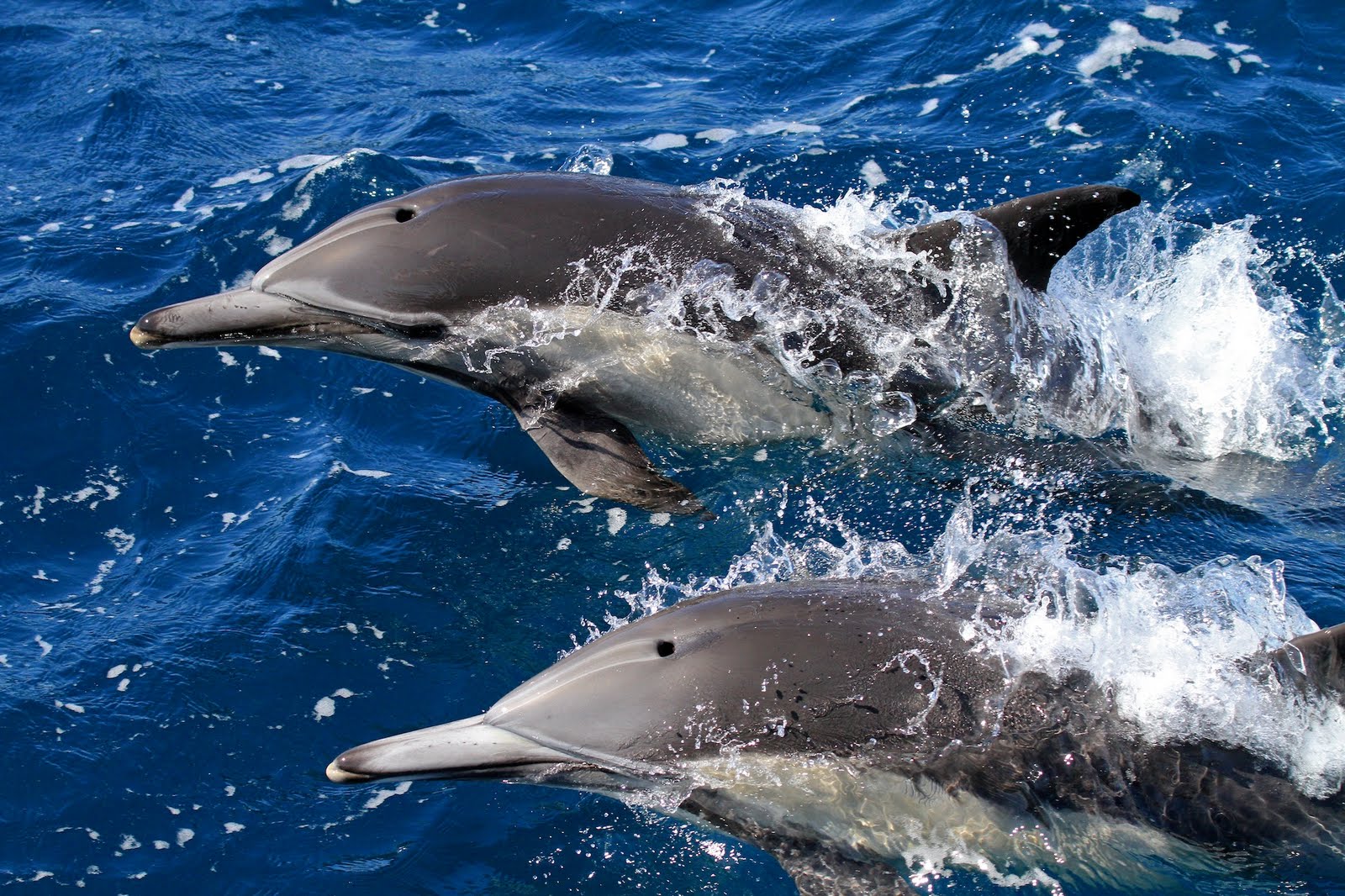
Wild Life of Common Dolphin


Common dolphin is the name given to two species (and possibly a third) of dolphin making up the genus Delphinus.
Before the mid-1990s, taxonomists identified only one species in this genus, the dolphin Delphinus delphis general. Modern Cetologists usually recognize two species - the dolphin Short-beaked common, defending Delphinus delphis systematic name, and long-beaked dolphin Delphinus capensis general. Some studies show that a third species, the common dolphin Emirates (D. tropicalis), can be characterized by extremely long and thin beak and found in the Red Sea and the Indian Ocean.

Common dolphin dolphin is not popular imagination despite its name, a difference that is owned by dolphin bottle as widely used in marine parks and appearance on the television series Flipper. However, this dolphin is most often represented in art and literature of ancient Greece and Rome.

The two species of common dolphins are medium sized dolphin. Adults range between 1.9 and 2.5 meters (6.2 and 8.2 ft) long, and can weigh between 80 and 235 kilograms (180 and 520 lb), although the range between 80 and 150 kilograms (180 and 330 lb) more generally. Men generally longer and heavier. Color pattern on the body is not normal. Dark back and white belly, while on each side is hourglass pattern in gray, yellow or gold in front and dirty gray in back. They have long, thin rostrums up to 50-60 small, sharp teeth on each side of each other every species of dolphins are common jaw.Both medium sized dolphin.

Adults range between 1.9 and 2.5 meters (6.2 and 8.2 ft) long, and can weigh between 80 and 235 kilograms (180 and 520 lb), although the range between 80 and 150 kilograms (180 and 330 lb) more generally. Men generally longer and heavier. Color pattern on the body is not normal. Dark back and white belly, while on each side is hourglass pattern in gray, yellow or gold in front and dirty gray in back. They have long, thin rostrums up to 50-60 small, sharp teeth on each side of the jaw mutually respectively.

Although historical practice genus Delphinus lumping them into one species, dolphins are widely distributed show a wide range of sizes, shapes and colors. It last for decades more than 20 different species in the genus has been proposed. Scientists in California in 1960 concluded that there are two species - the long and short beaked beaked. This analysis essentially confirmed by a further study of genetic in the 1990s. The study also shows that a third species (D. tropicalis, common name usually common dolphin Arabic), characterized by extremely long and thin beak and found in the Red Sea and the Indian Ocean, may be distinguished from the long-beaked species. Standard taxonomic works of seconds to realize this is just as various regions.

Thursday, January 10, 2013

Oceanic Dolphin a Mammals Animal


Marine dolphin family Delphinidae Cetacea. Marine mammals related to whales and dolphins. They are found throughout the world, especially in the shallow water of the continental shelf. As the name suggests, these dolphins tend to be found in the open ocean, not like the river dolphin, although some species such as the Irrawaddy dolphins that beach or river.

Six of the larger species in the Delphinidae, the Orca and Pilot (long-finned and short-finned), Melon-headed, Pygmy Killer and Pope, commonly called whales, dolphins are not, they are also sometimes collectively known as "blackfish".

The Delphinidae most diverse cetacean family, with many variations among species. They range in size from 1.2 meters (3.9 feet) and 40 kilograms (88 pounds) (Haviside's dolphin), up to 9 meters (30 ft) and 10 tonnes (Orca). Most of the species has a weight between about 50 and 200 kilograms (110 and 440 lb). They usually have a curved dorsal fin, a 'half' clearly on the front of the head, forehead melons, though there are exceptions to all rules. They have a wide range of colors and patterns.

Delphinids Most especially eating fish, along with a small amount of squid and small crustaceans, but a few species specialize in eating squid, or, in the case of Orca, also eat marine mammals. All, however, are pure carnivores. They usually have between 100 and 200 teeth, although some species have much less.

Delphinids travel in large pods, which might number a thousand people in several species. Each pod emerald span of several dozen to several hundred square miles. Some pods have a loose social structure, with individuals often join or leave, but others seem to be more permanent, perhaps dominated by men and 'harem' girls. Individuals communicate by voice, whistles produce low frequency, and also produce high-frequency broadband clicks from 80-220 kHz, which is mainly used for echolocation. Pregnancy lasts 10-12 months, and results in the birth of a single calf.

Wednesday, January 9, 2013

Australian Snubfin Dolphin Extraordinary Animal


The Australian snubfin dolphins (Orcaella heinsohni) is a dolphin found off the coast of northern Australia. This is similar to the Irrawaddy dolphin (from the same genus, Orcaella) and not described as a separate species until 2005. The snubfin Australia is tri-coloured, while the Irrawaddy dolphin only has two colors on her skin. Skull and fins also show small differences between the two species.

Taxonomic name, Orcaella heinsohni, was chosen to honor George Heinsohn, Australian biologist who works at James Cook University, "to work on odontocetes rintisannya of Australia, including the collection and preliminary analysis of the specimen Orcaella heinsohni which forms the basis for much of our knowledge about new species ".

A new species of large mammals rarely paid enough this time, and the people who are usually from remote areas - such as Saola - or rather rare, see for example Perrin beaked whale, or spade-toothed whale, known only from two complete specimens and some bones were stranded. In fact, snubfin Australia is the first species of dolphins that will be explained in 56 years, but was followed, in 2011, the findings and evidence from Burrunan dolphin (T. australis), also from the continent of Australia. Australia snubfin dolphin unusual among mammals in the population just described are accessible for scientific research.

Nevertheless, the existence of snubfin dolphins in the waters of northern Australia only became famous in 1948, when the skull was found in Melville Bay (Gove Peninsula, Northern Territory). This individual appears to have been caught and eaten by the natives. However, the findings remain unnoted until discussed by Johnson (1964), and shortly afterwards a Dutch captain has come to be known-species observations published.

Two scientists, Isabel Beasley from James Cook University and Peter Arnold Museum of Tropical Queensland, take a DNA sample from the population of dolphins off the coast of Townsville, Queensland, and sent them to the National Oceanic and Atmospheric Administration Southwest Fisheries Science Center in La Jolla, California. The results showed George Heinsohn true in the hypothesis that the population of Townsville is a new species.
The holotipe QM JM4721 (JUCU MM61) is a skull and some other bones of an adult male was found drowned in shark nets at Horseshoe Bay, Queensland, on 21 April 1972. That's about 11 years old at the time of his death.

A delphinid species in the genus, Orcaella, which contains one other species, the Irrawaddy dolphin Orcaella brevirostris, O. heinsohni is fine tri-color: brown, on the light brown along the sides, and white belly, Irrawaddy dolphin, on the other hand, is uniformly slate gray except for a white belly. The new species has a rounded forehead, very different from other dolphin species in Australia, and, very small "Snubby" dorsal fin distinguishes it from other dolphins in coverage. The lack of grooves on each side of the back and neck folds over the availability of this species from relatively distinguish.

In the Pacific Ocean from Townsville, about 200 individual snubfin dolphin found. The range of this species is expected to expand into Papua New Guinea, namely, O. heinsohni is endemic to the northern part of the Sahul Shelf, but the majority live in the waters of Australia. They are not considered public, and is being given high conservation priority. IUCN classification of "lack of data" refers to this species and the Irrawaddy dolphin combination (Cetacean Specialist Group 1996). Threats including submerged in the fishing industry and antishark nets, while some hunting by indigenous people may occur (as evidenced by the specimen 1948), this may be insignificant compared to the threat of drowning.